
Face-down pillow
Keep your face toward the floor without stacking bed pillows.
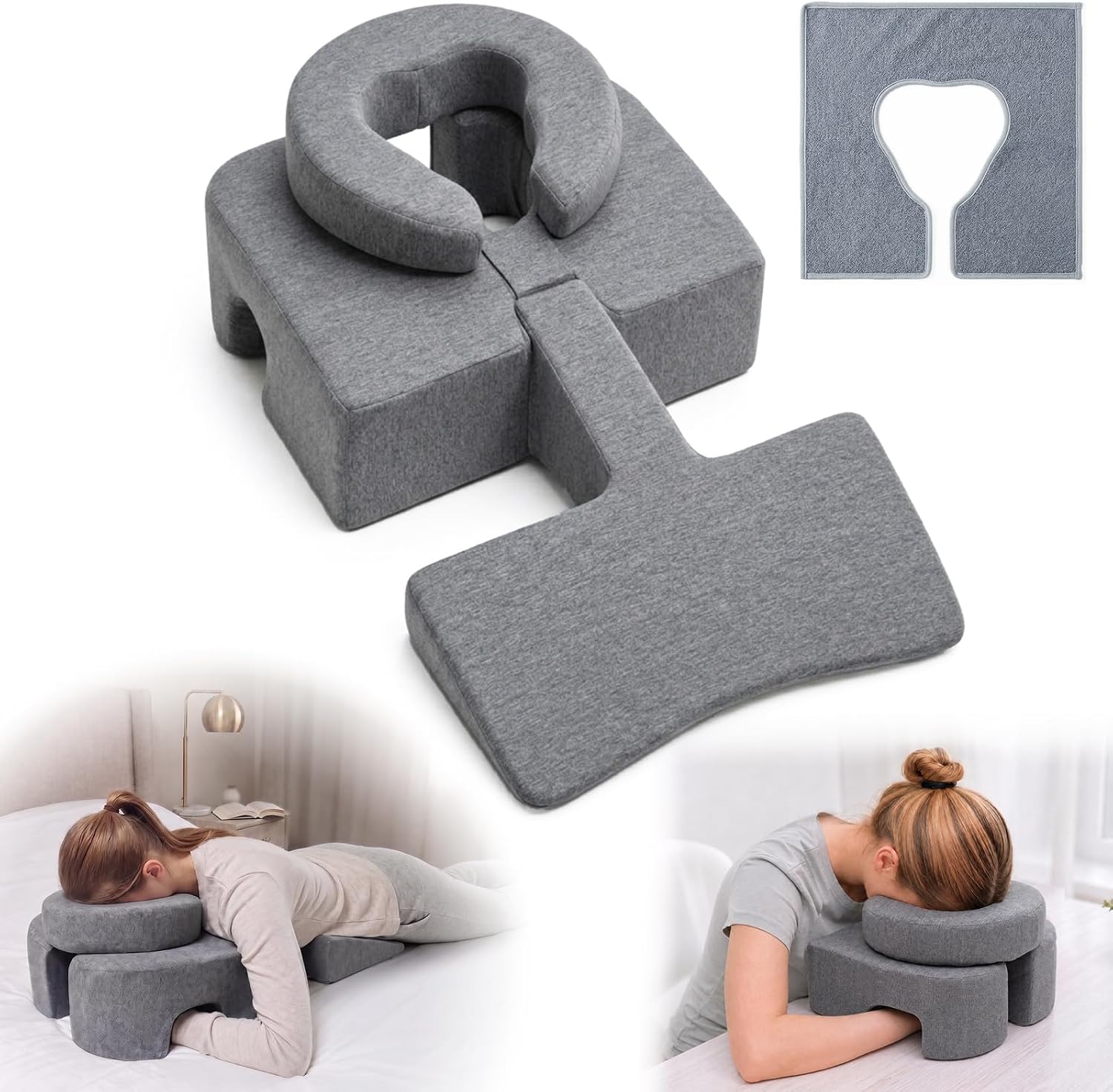
Two modules: an open head cradle and a sliding chest riser. Hook-and-loop join. Bed at night. Desk by day.


On Amazon list price: $49.99 as of 2 Sep 2026. Checkout on Amazon; price may vary.
| Modules | Head cradle + sliding chest riser |
|---|---|
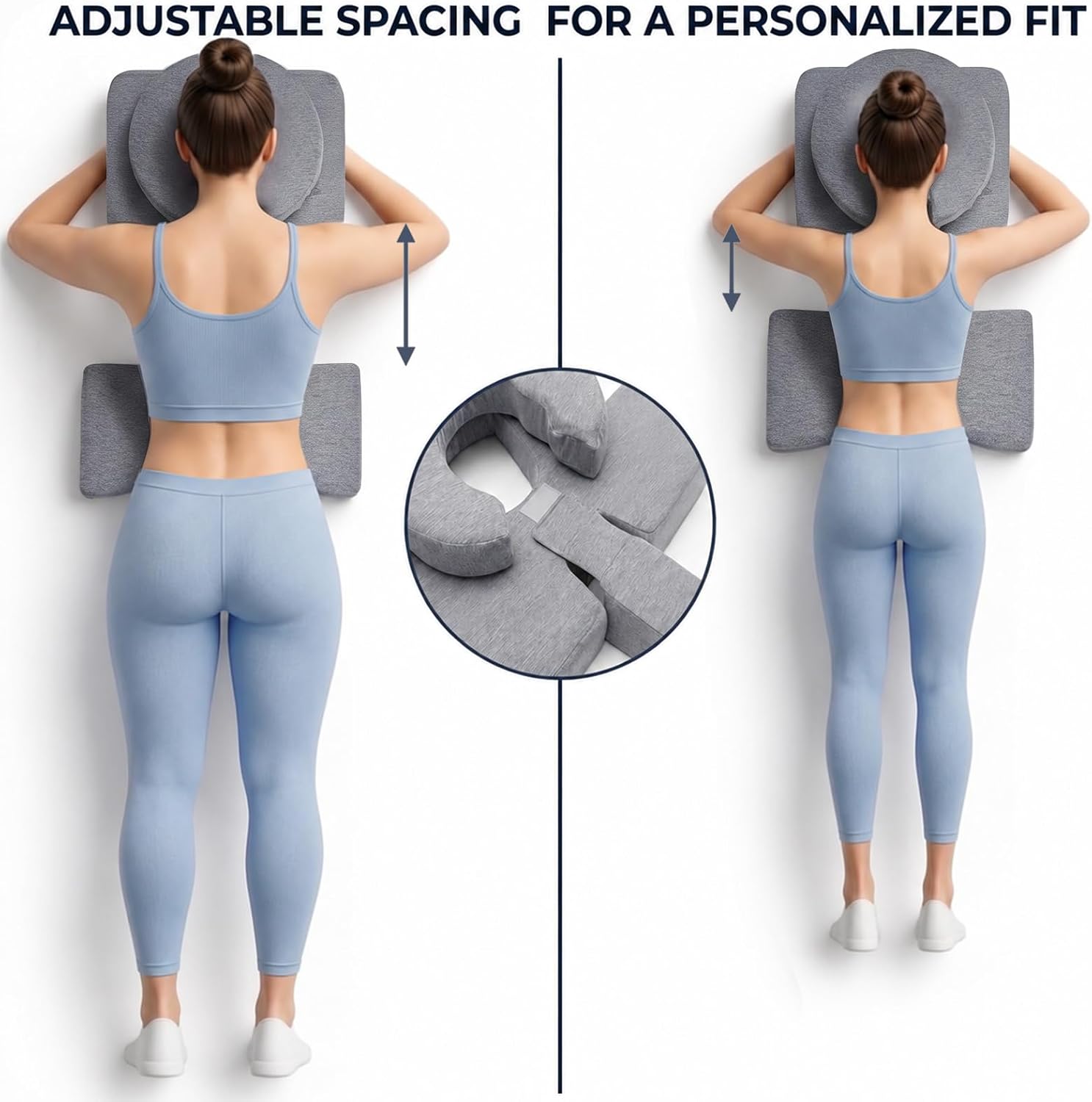
| Join | Hook-and-loop track; slide closer or farther |
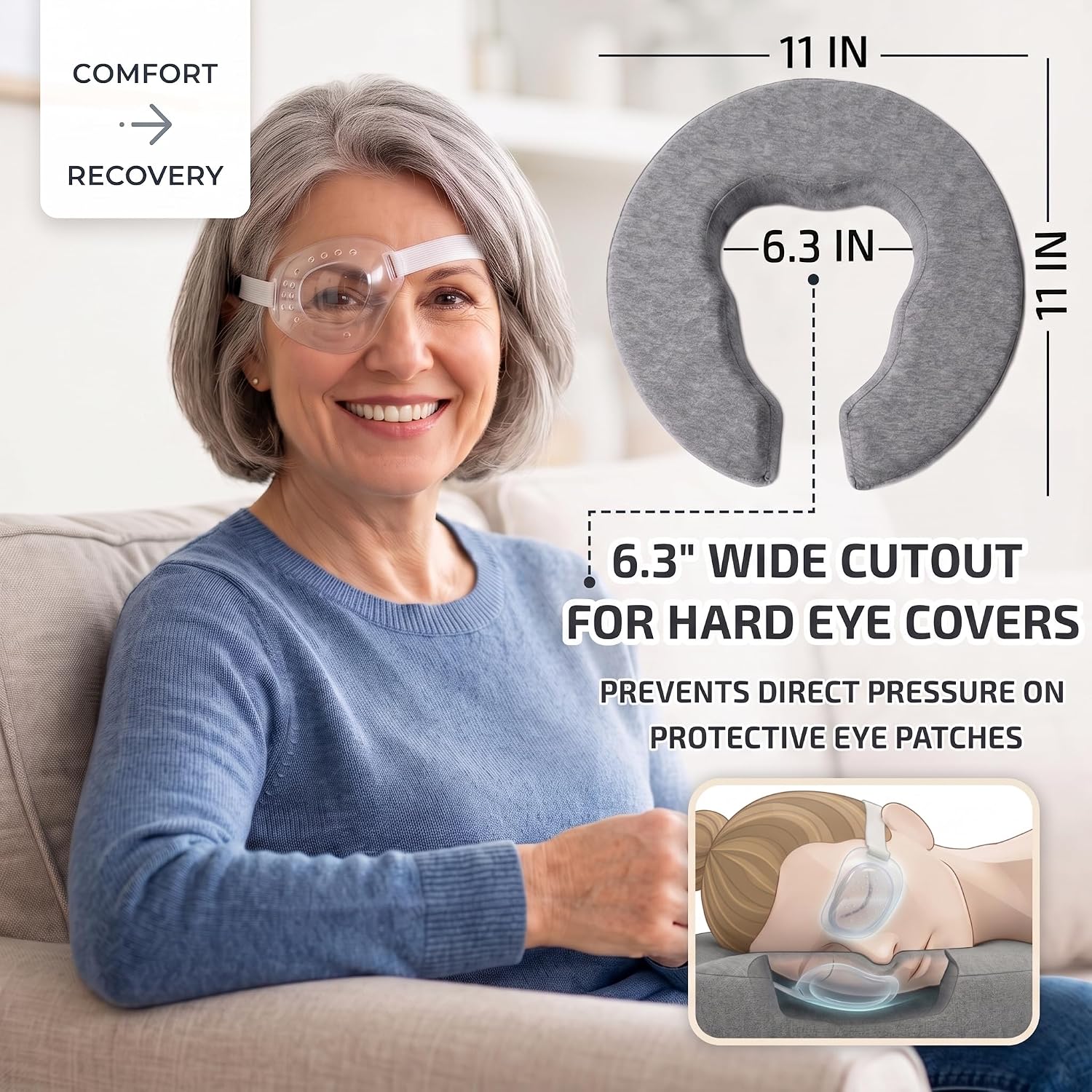
| Head module | About 11 × 11 in (listing-image label) |
| Face cutout | 6.3 in wide (listing-image label: hard eye covers) |
| Openings | Open face cradle, center channel, side arm openings |
| Foam / cover | Foam; cotton-jersey zip cover, removable, washable |
| Use spots | Both modules on the bed; head module at a table or desk |
| Color | Grey |
| ASIN | B0H33C1H4S |
Head cradle plus sliding chest riser. Both modules on the bed; head module alone at a desk.
Why this shape
The chest riser slides so your ribcage sits up. Your face sits in an open cradle, not in a stack of pillows.
Two pieces. The head module is an open cradle with a center channel. The chest riser is a separate pad on a hook-and-loop track. You slide it to the length of your own torso.
The listing image labels the head module about 11 × 11 in, with a 6.3 in cutout marked for hard eye covers. Side arches let the arms run through instead of pinning them under the chest.
Use both modules on the bed for a long prone rest. Take the head module alone to a table or desk when you need the same face-down hours sitting up. Removable cotton-jersey cover; wash it.
Folded bed pillows flatten the chest and close the space under the face.
The Amazon listing title-line is “Face Down Pillow After BBL or Eye Surgery.” The eye-surgery use is the rest position in those hospital leaflets, if your surgeon prescribed it. The BBL use is the same shape: chest on the riser, face in the cradle. That is a design description, not a surgical-result claim.
The listing also names daytime face-down rest, evening naps, and a home massage or facial setup. Take the head module to a table to read or use a phone without lifting your head.
A stack sinks. The face ends up in fabric. The belly is pressed into the mattress. This cradle stays open. The riser holds the ribcage up so you are not rebuilding the stack every hour.
What clinicians say
Moorfields: face-down means the nose points at the floor — at a table on a cushion, or prone into a face-down pillow.
When a vitreoretinal surgeon prescribes face-down rest after a gas bubble, the hospital leaflets describe the same two postures this pillow is built for: sitting, head on a cushion; or lying on the stomach, face into a face-down pillow.
Moorfields Eye Hospital NHS Foundation Trust (September 2025): if advised, typically 3 to 7 days, 45 to 50 minutes of every hour, with a 10 to 15 minute break. Face-down means the nose points at the floor.
Sandwell and West Birmingham NHS Trust / Birmingham Midland Eye Centre (December 2024): start as soon as you can; often up to 10 days; 45 to 50 minutes of every hour in the day; a 10-minute break for toilet, food, and a short stretch. They name a rented or purchased face support as a posturing aid.
This pillow is that rest shape. It is not a treatment, and it does not set your hours. Your surgeon does.
Face-down means the nose points at the floor: at a table on a cushion, or prone into a face-down pillow. Moorfields Eye Hospital NHS Foundation Trust, September 2025
Macular Hole: Your guide to Macular Hole Surgery. Patient Information Leaflet. Moorfields Eye Hospital NHS Foundation Trust, City Road, London EC1V 2PD. Author: Robbie Walker, Locum Consultant Vitreo Retinal Service; Yvonne Kana, Nurse Consultant Vitreo Retinal Service. Revision 5. Approval date September 2025. Review date September 2028.
Excerpt of “Posturing after surgery: Face-down positioning,” not the full leaflet.
Your surgeon will advise you if you need to posture after your surgery. For some macular holes, face-down posturing is very important to help the gas bubble press against the macula and maximise the chance of the hole closing.
How long? If advised, you will typically need to maintain a face-down position for between 3 and 7 days, usually for 45 to 50 minutes of every hour during the day. You can take a 10 to 15-minute break each hour for things like eating, using the toilet, and gentle stretching.
What it means: Face-down means your nose is pointing towards the floor. This can be achieved by: sitting at a table with your head resting on your arms or a cushion; lying on your stomach (prone) in bed with your face looking towards the floor off the end of the bed, or into a special face-down pillow; walking with your head looking towards your toes.
Tips for posturing: Whilst generally not required, you can hire or buy special equipment to help with posturing, such as face-down chairs or support pillows.
Moorfields Eye Hospital NHS Foundation Trust. Macular Hole: Your guide to Macular Hole Surgery. September 2025.
Verified 28 Aug 2026 from the original PDF.
After retinal surgery with gas or oil: face-down is one prescribed head position; a face support is a named posturing aid. Sandwell and West Birmingham NHS Trust / Birmingham Midland Eye Centre, December 2024
Post operative posturing following retinal surgery and insertion of a bubble of gas/oil. Information and advice for patients. Ophthalmology. M7664. Issue date December 2024. Review date December 2027. Sandwell and West Birmingham NHS Trust. Department: Vitreo-Retina. Birmingham Midland Eye Centre (BMEC), Dudley Road, Birmingham B18 7QH. A Teaching Trust of The University of Birmingham.
Excerpt of the posturing definition, daytime hours, and the face-support tip — not the full leaflet.
Posturing describes the position of your head and upper body that you need to adopt following your operation.
It is used after retinal surgery to ensure the gas or silicon oil bubble in the eye is positioned against the part of the retina that needs to be flattened.
Usually, you will need to posture for up to 10 days keeping your head in the right position for 45-50 minutes of every hour during the day. You can take a 10-minute break each hour for things like toileting, eating and gentle exercises.
You can use a posturing aid (called a face support) which can be rented/purchased online. Arrange your pillow to support the rest of your body while maintaining the correct posture.
The ward diagrams include: face down; face down, right or left cheek to pillow; sitting upright; left side; right side. The ward nurses advise which position and duration.
Sandwell and West Birmingham NHS Trust. Post operative posturing following retinal surgery and insertion of a bubble of gas/oil. M7664. December 2024.
Verified 28 Aug 2026 from the original PDF.
After surgery
What to skip after surgery
- If a vitreoretinal surgeon prescribed face-down rest, follow the hours they set. This pillow does not set your hours.
- Face-down means the nose points at the floor (Moorfields). Do not lift the head during the prescribed minutes.
FAQ
Questions people ask
- Is the face opening size adjustable on this face down pillow, or is it fixed?
- No, the face opening itself stays a fixed shape — what you can adjust is the gap between the two modules, sliding them closer or farther apart to match your own torso length. That same head module works as a massage headrest for bed during at-home sessions, so the adjustable part is where support sits, not the opening.
- Does this face down pillow have two pieces that can actually come apart?
- Yes, the head and chest modules connect with a hook-and-loop strip, so you can pull them apart whenever you need to. That same connection is what lets you slide the pieces to fit your torso, and the head module alone works as a massage headrest for bed once it's set up on its own for a home session.
- Can I use just the head module on this face down pillow without the chest piece?
- Yes, the head module detaches and works fine on its own — that's exactly how it's meant to be used on a table or desk during the day so you can stay face down while you read or eat. Used that way, the same piece serves as a massage headrest for bed later on.
- For someone tall, how far apart can the pieces go on this face down pillow?
- There's no set distance — you keep sliding the head and chest modules apart along the hook-and-loop strip until the gap actually matches your own torso length, which is what a taller frame usually needs. That same head module also turns into a massage headrest for bed once you split it off for a shorter home session.
- What makes this vitrectomy recovery equipment different from just stacking my own bed pillows at home?
- This gives you two connected modules, a head cradle and a chest riser, that lock into a set position with hook-and-loop, rather than a loose stack of pillows you have to keep re-piling as it slips apart. The same two-piece idea used here is close to what you would find in a bbl sleeping pillow, positioned and locked instead of stacked and shifting under you.