
Sacral-coccyx cushion
Sit or lie without putting your tailbone on the pad.
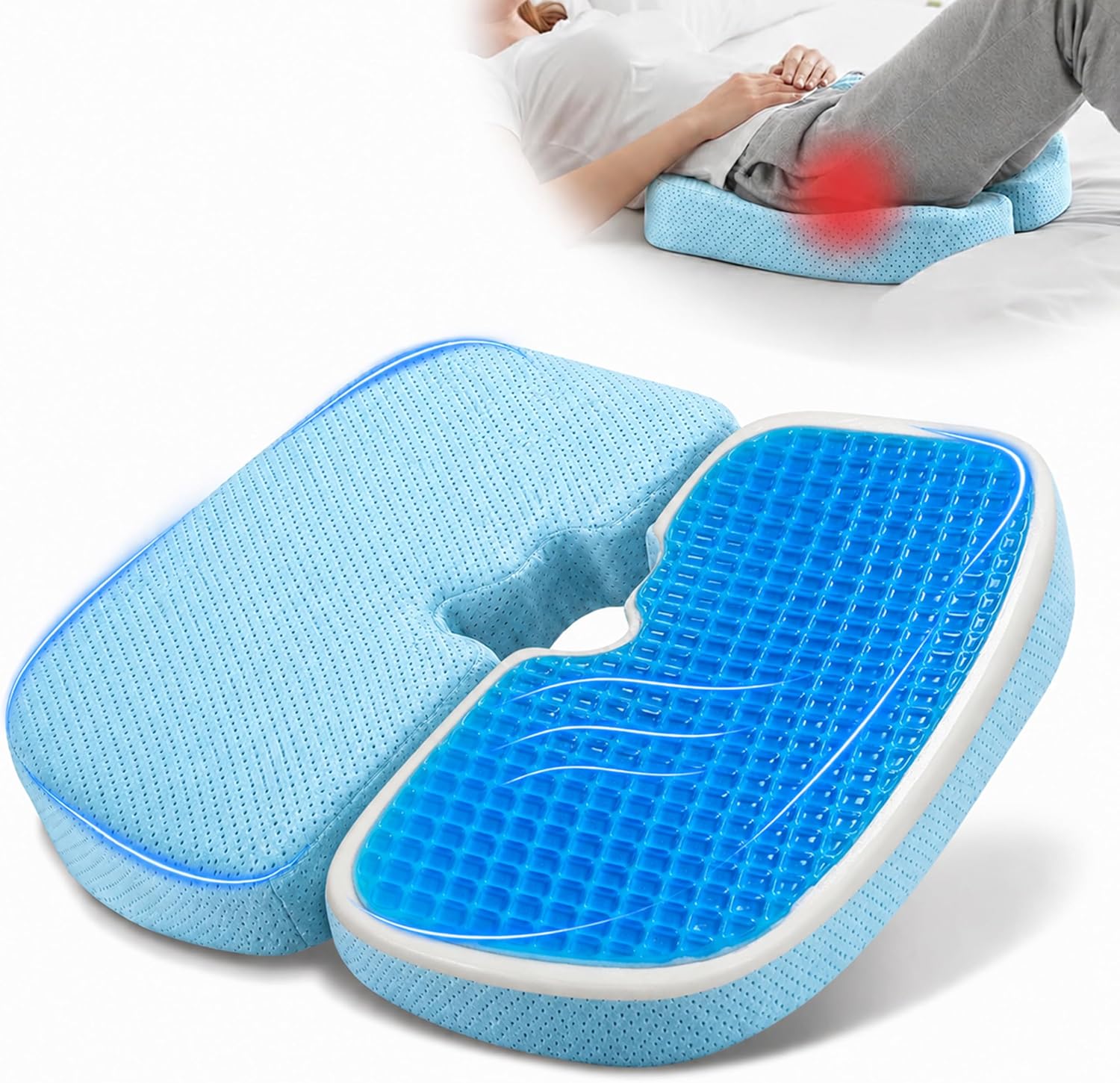
Two foam pieces leave a hollow in the middle. You sit or lie so the sacrum and tailbone rest in the gap, not on the foam.
On Amazon list price: $49.99 as of 2 Sep 2026. Checkout on Amazon; price may vary.
| Build | Two modular pads with straps; hollow center |
|---|---|
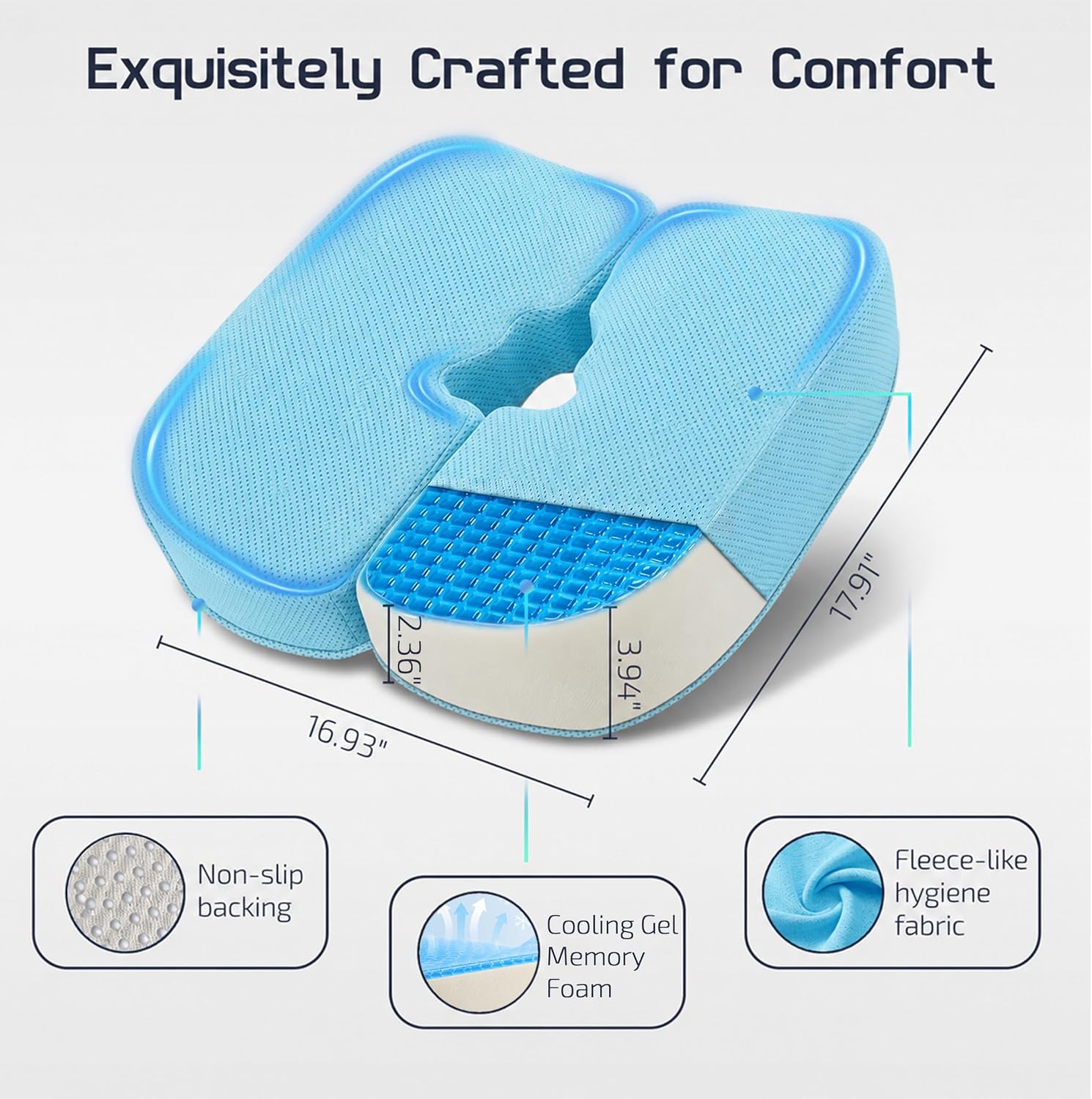
| Labeled size | 16.93 in wide × 17.91 in deep; back 3.94 in, front 2.36 in (listing images). Amazon details also list 19 × 19 × 4 in. |
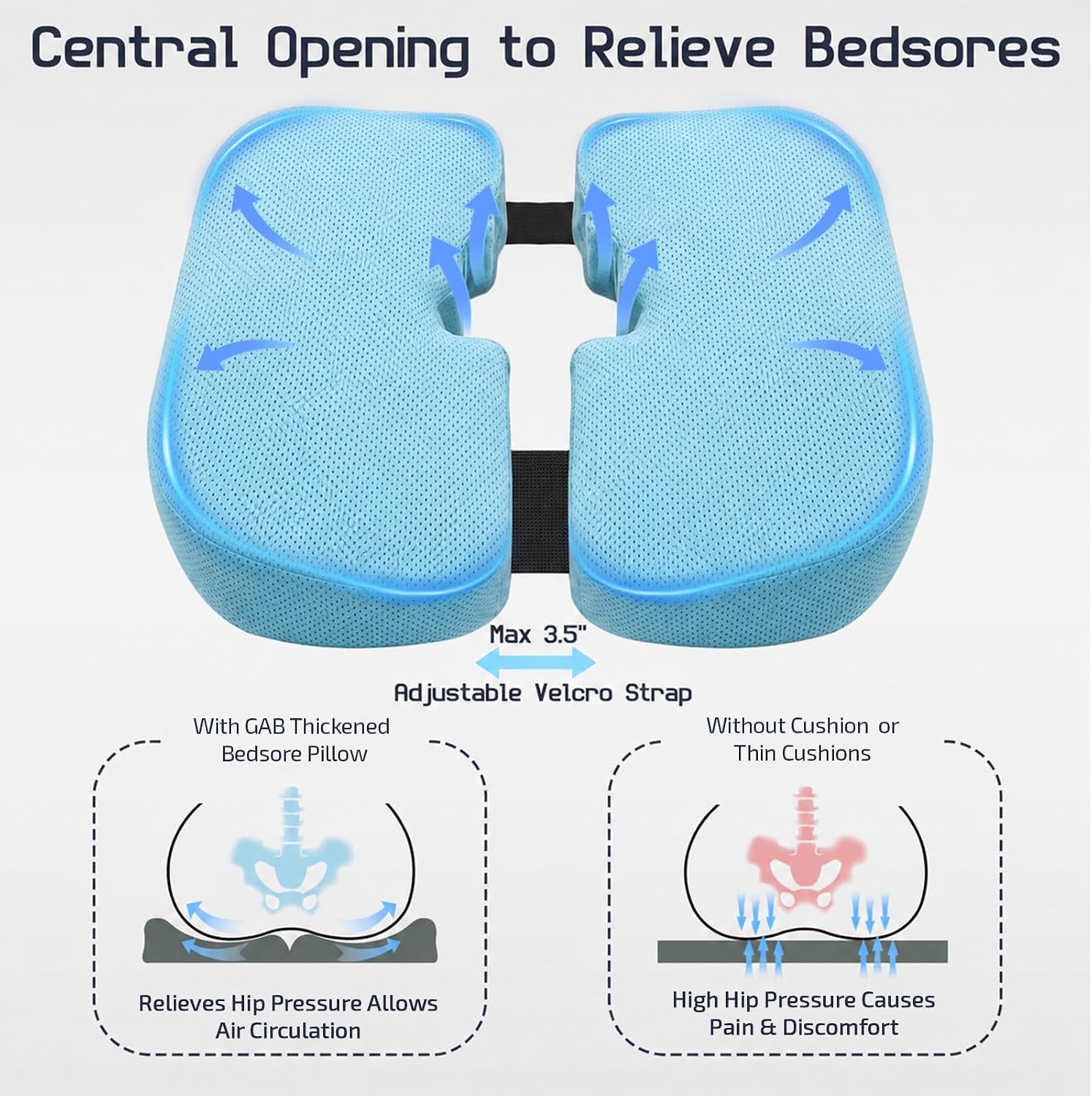
| Center gap | Adjustable; listing images label a maximum of about 3.5 in |
| Foam | Memory foam, medium-soft, with gel pads |
| Cover | 100% polyester, zipper, machine wash |
| Bottom | High-traction |
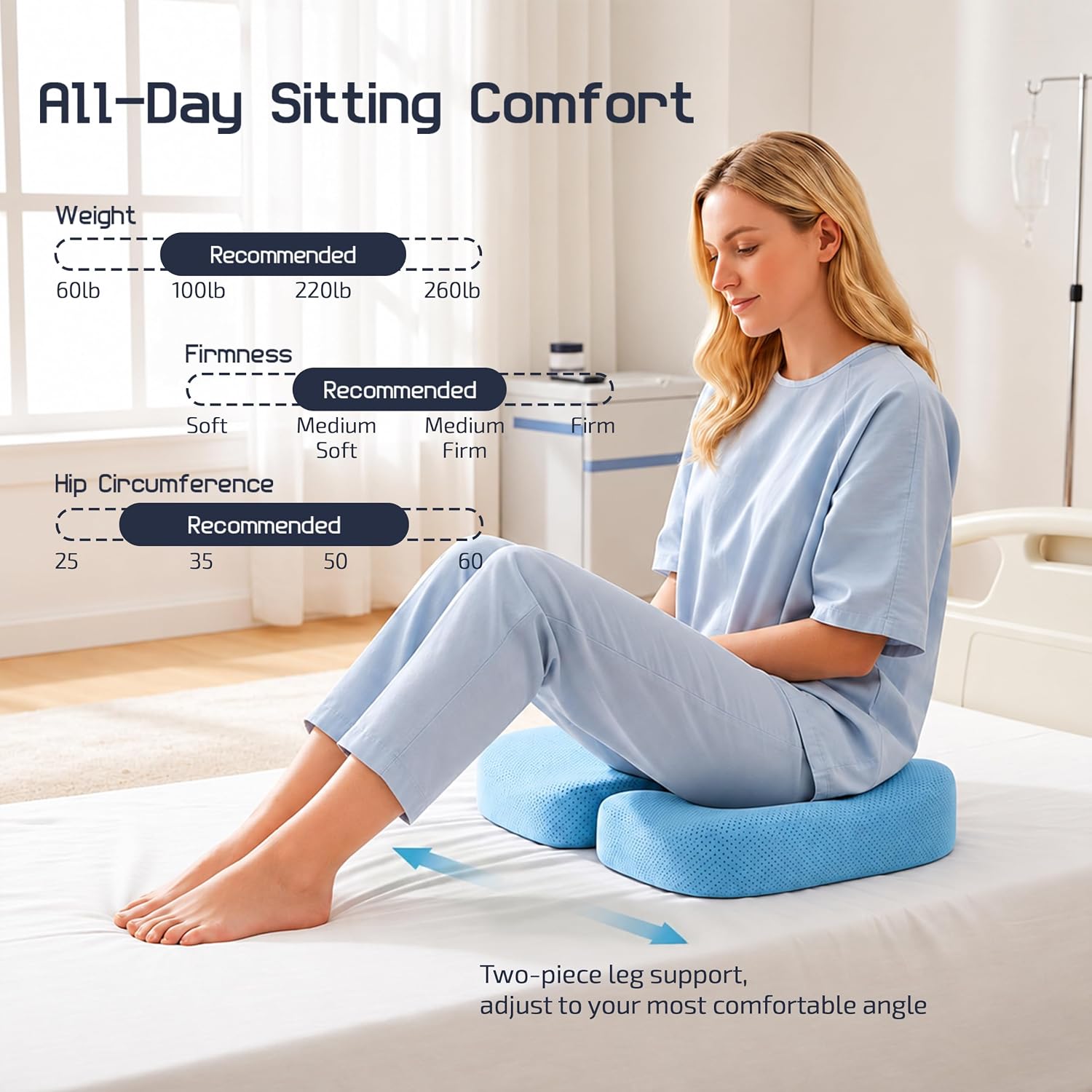
| Labeled fit | Listing images: 100–220 lb; hip circumference 35–50 in |
| Blue | ASIN B0GTV8F897 |
| Gray | ASIN B0GSFLZC21 |
| Parent | ASIN B0H5J1H4W7 |
Hollow center. Gel over foam. The midline of the pelvis is the gap, not the seat.
Why this shape
The hollow is the point. Your sacrum and tailbone sit in the gap, not on the foam.
Two pads, with straps between them. You slide the gap. Listing images label a maximum of about 3.5 in. Use both pieces together, or as two separate pads under the hips.
It is thicker at the back than the front: 3.94 in and 2.36 in on the listing diagram. Gel pads over memory foam. A polyester zip cover you can machine wash. A high-traction bottom so the pad stays on a sheet or a chair.
A flat pillow still puts the tailbone on foam. A one-piece donut has a fixed hole.
Use it in bed or in a chair. After surgery or after birth, if the order is to keep that bony midline from being the seat. Listing images label a fit of 100–220 lb and hip circumference 35–50 in.
Blue or Gray. Same pad.
Two pieces let you set the gap. A high-traction bottom stays on the sheet instead of sliding into a pile.
What clinicians say
Pressure redistribution is a positioning problem. A pad does not replace turning.
The 2026 NPIAP / EPUAP / PPPIA international guideline, Repositioning and Mobilization chapter, says extended lying or sitting on one part of the body, without redistributing the pressure, deforms tissue.
The same chapter: reposition so you offload pressure points and redistribute load. Positioning devices can hold a position or lift a body part off the surface. No support surface entirely replaces repositioning.
This cushion is that kind of device: a hollow so the sacral midline is not the contact. It is not a turning schedule. It is not a treatment.
Pressure redistribution is a positioning problem; no support surface entirely replaces repositioning. NPIAP / EPUAP / PPPIA, International Guideline, 2026
Repositioning and Mobilization. In: Prevention and Treatment of Pressure Ulcers/Injuries: Clinical Practice Guideline. The International Guideline: Fourth Edition.
Excerpt from the introduction and good-practice statements R1–R2, not the full chapter.
The underlying cause of pressure injuries (PIs) is multifaceted; however, by definition, pressure injuries cannot form without mechanical loading acting on the tissue. Extended periods of lying or sitting on a particular part of the body without redistributing the pressure leads to deformation of tissues and, ultimately if damage thresholds are exceeded, tissue damage in the form of a PI.
R1: It is good practice to reposition individuals with or at risk of pressure injuries regardless of the type of pressure redistribution full body support surface being used. … However, no support surface can entirely replace repositioning.
R2: It is good practice to reposition the individual in such a way that optimal offloading of pressure points and maximum redistribution of pressure are achieved.
Use positioning devices. These devices can assist in maintaining positioning, be used to elevate parts of the body off the support surface, and can promote body symmetry, posture and comfort.
National Pressure Injury Advisory Panel, European Pressure Ulcer Advisory Panel and Pan Pacific Pressure Injury Alliance. Repositioning and Mobilization. In: Prevention and Treatment of Pressure Ulcers/Injuries: Clinical Practice Guideline. The International Guideline: Fourth Edition. Emily Haesler (Ed.). 2026. Published online 24 August 2026.
Verified 28 Aug 2026 from the public chapter. This page does not claim the cushion prevents pressure injuries.
After surgery
What to skip after surgery
- Do not treat this pad as a turning schedule. The 2026 NPIAP / EPUAP / PPPIA guideline: no support surface entirely replaces repositioning.
- Do not leave one part of the body loaded without redistributing the pressure — that is the positioning problem the guideline describes.
FAQ
Questions people ask
- Is a 'donut cushion' the same thing as a dedicated tailbone donut pillow, and which is this?
- Yes, they're the same shape, and this is the tailbone-specific version. 'Donut cushion' is the general term, and a version like this one is that shape sized and cut for tailbone use rather than a generic seat pad. The same design is also sold as a broken tailbone pillow, since the open center works for either purpose.
- Is this a full-ring donut pillow for tailbone support, or does it use a horseshoe-shaped cutout instead?
- It's both, depending on how you set it up — joined together, the two halves of this buttocks cushion form a closed ring around the tailbone; split apart, each half works more like a horseshoe cutout on its own. A full ring generally isolates the tailbone most completely, while a horseshoe leaves one side open, so this two-piece build lets you pick either.
- Can the two pieces of these butt cushions for pressure relief be used separately, not just together?
- Yes — a Velcro strip joins them and pulls apart in a second, and each half is cut and layered the same way. Joined, they form one foam donut cushion with the opening in the middle for sitting. Apart, one half tucks under a hip or the sacrum of someone in bed and moves to the other side at each position change; a single half also travels easily.
- For a larger frame, will the tailbone touch the edge of this sitting donut cushion tailbone opening?
- Not necessarily, and you can widen it if it does — the two halves are joined by an adjustable hook-and-loop strap that opens the center gap to a maximum of 3.5 inches, so the clearance is yours to set. Closed, this bed cushion measures 19 by 19 inches with a 4-inch thickness.
- As a caregiver, can a sacral cushion pressure relief pad replace scheduled turning schedules for bedbound patients?
- No — turning schedules are set by your care team, and nothing here replaces them. It's a positioning aid: a pressure redistribution cushion that spreads weight across the buttocks and sacrum between turns. The two pads work with that routine — one half goes under a hip to hold a slight tilt, then moves to the other side at the next turn. Intervals stay your clinician's call.