
On Amazon
Donut pillow for tailbone pain
A hollow under the coccyx so that bone is not the load. Offload only — not a treatment claim.
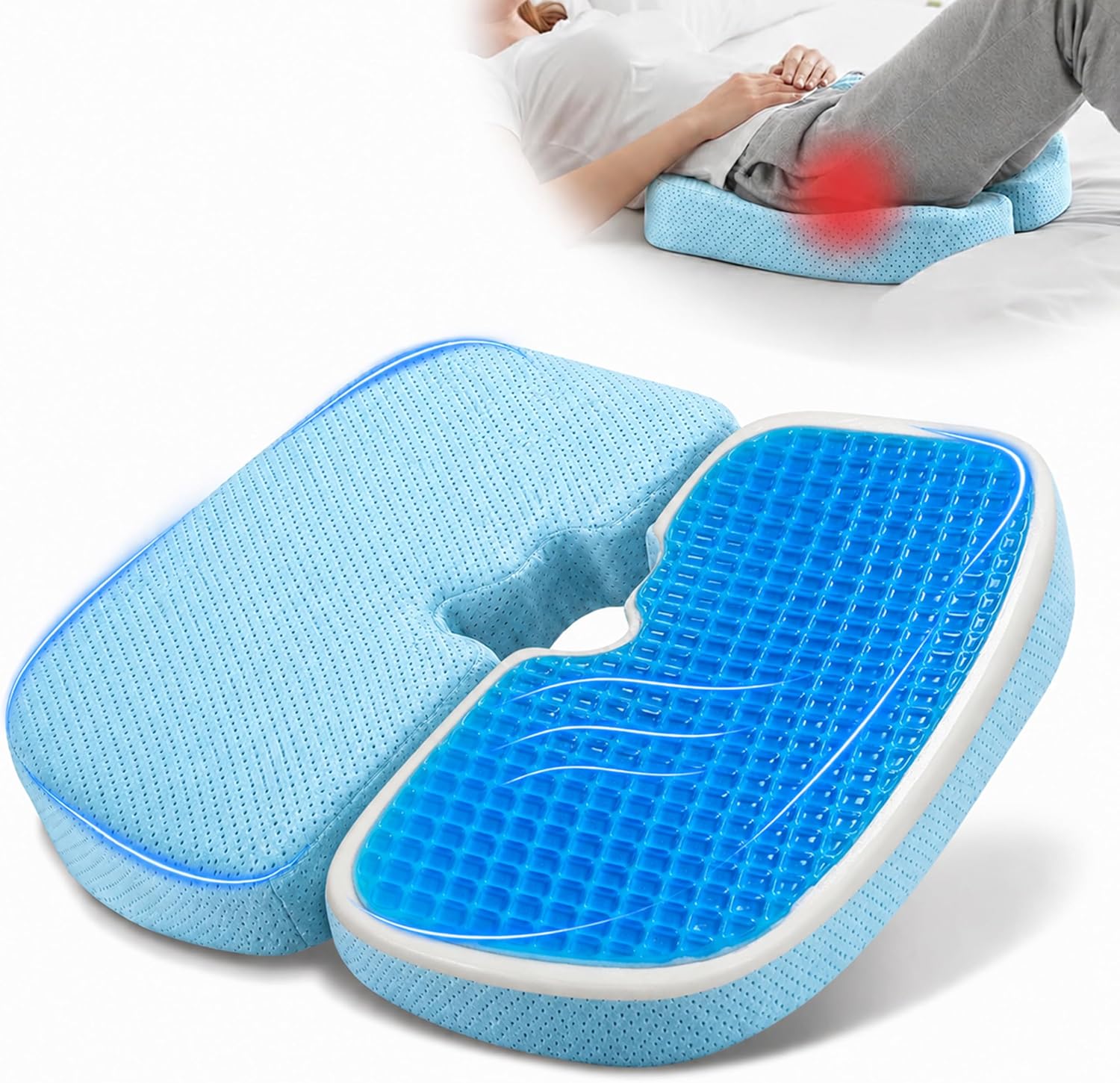
- Open center under the tailbone, not a flat pad.
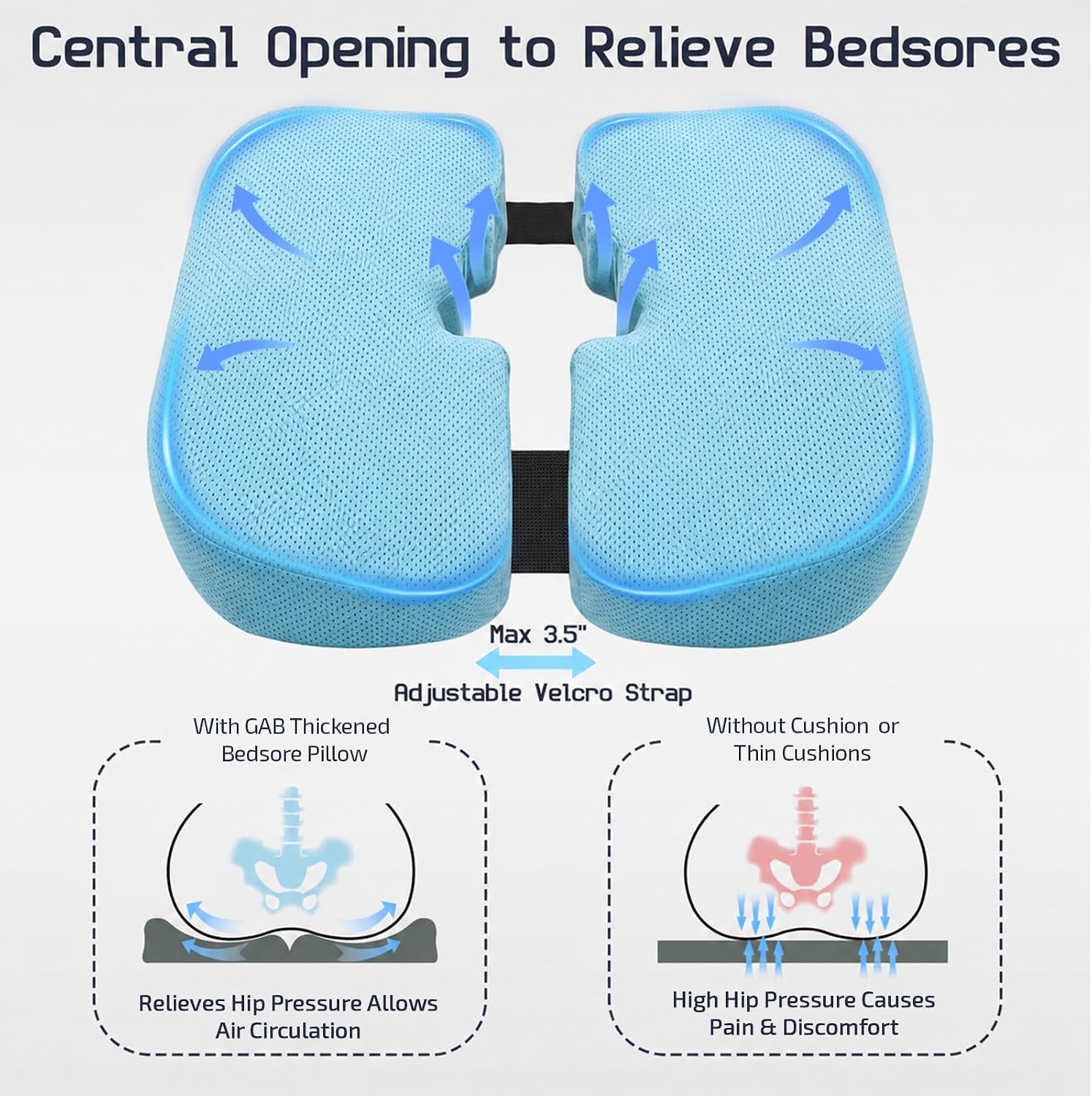
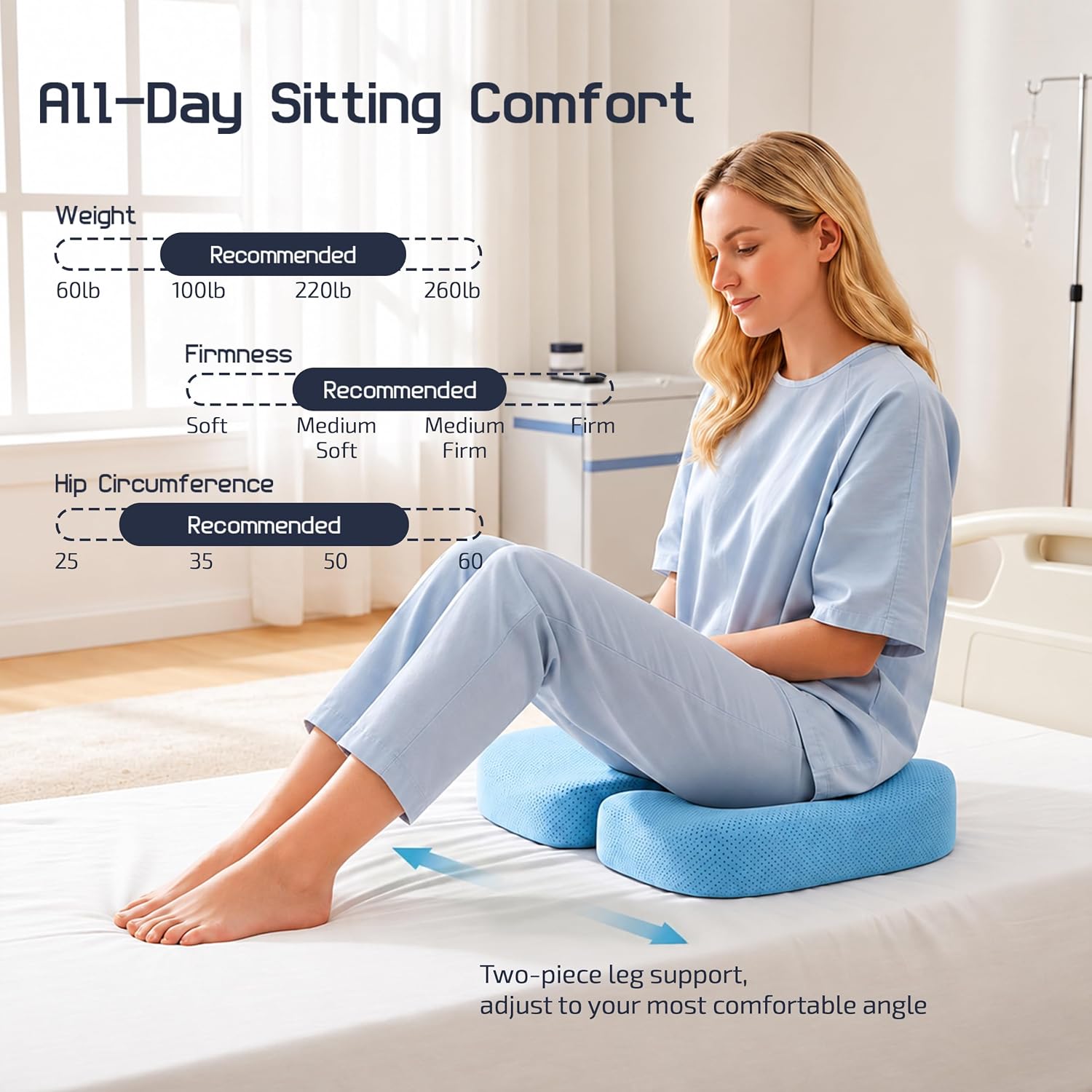
- Two halves adjust the gap; use joined or apart.
- This is a positioning cushion. Follow your clinician. You buy on Amazon.
On Amazon list price: $49.99 as of 2 Sep 2026. Checkout on Amazon; price may vary.
For donut pillow for tailbone pain, checkout stays on Amazon.
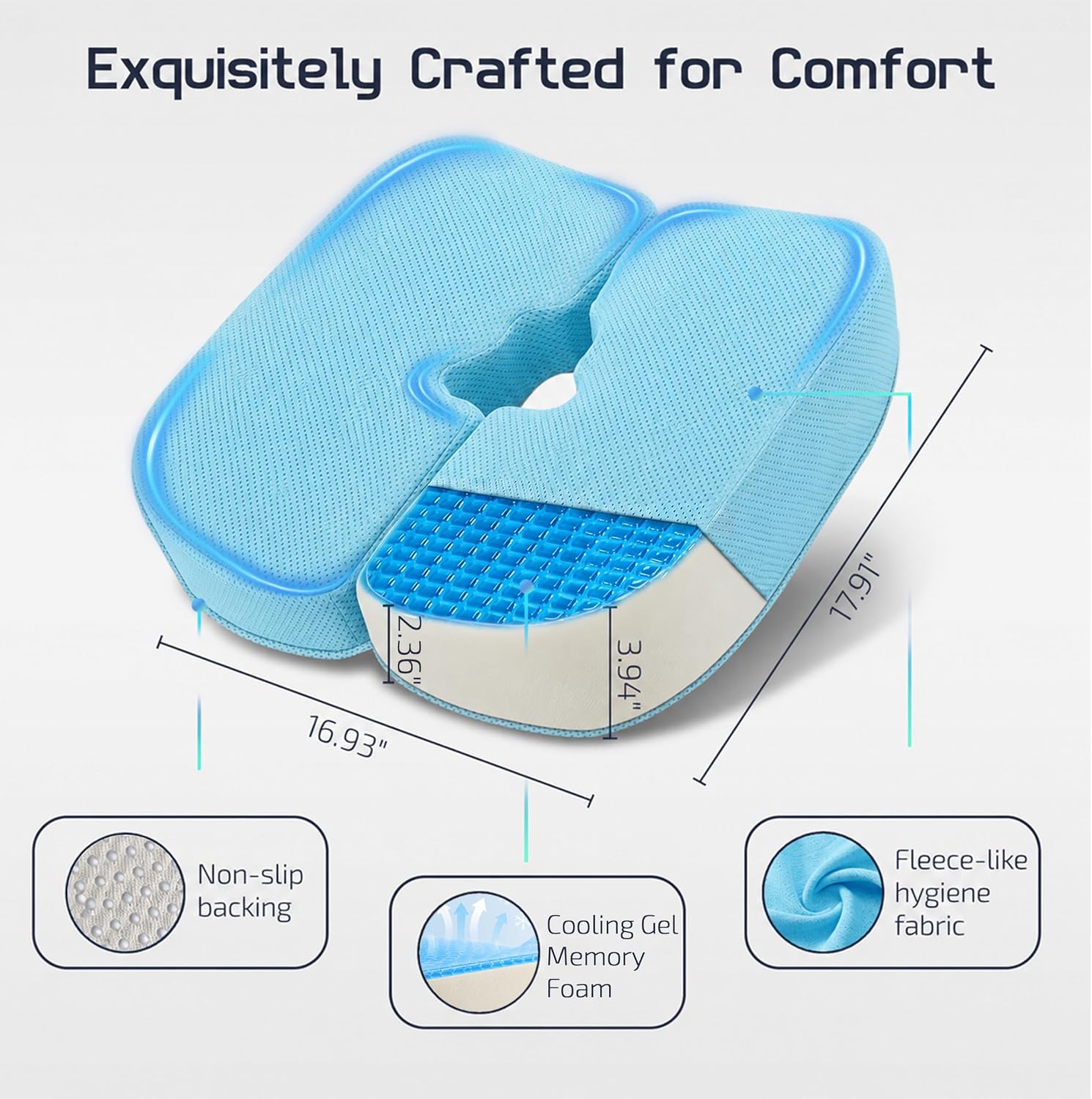
| Build | Two modular pads with straps; hollow center |
|---|---|
| Labeled size | 16.93 in wide × 17.91 in deep; back 3.94 in, front 2.36 in (listing images). Amazon details also list 19 × 19 × 4 in. |
| Foam | Memory foam, medium-soft, with gel pads |
| Parent | ASIN B0H5J1H4W7 |
How it is designed
Two-piece foam with a hollow center. Straps between the pads so you can slide the gap.
Thicker at the back than the front: 3.94 in and 2.36 in on the listing diagram. Gel over memory foam. Sit or lie so the sacrum and tailbone are not the load.
Why this shape
A flat pillow still puts the tailbone on foam. A one-piece donut has a fixed hole.
This is positioning. It is not a pressure-ulcer treatment.
What to skip
- Do not treat this pad as a turning schedule. The 2026 NPIAP / EPUAP / PPPIA guideline: no support surface entirely replaces repositioning.
- Do not leave one part of the body loaded without redistributing the pressure — that is the positioning problem the guideline describes.
Questions people ask
- Is a 'donut cushion' the same thing as a dedicated tailbone donut pillow, and which is this?
- Yes, they're the same shape, and this is the tailbone-specific version. 'Donut cushion' is the general term, and a version like this one is that shape sized and cut for tailbone use rather than a generic seat pad. The same design is also sold as a broken tailbone pillow, since the open center works for either purpose.
- Is this a full-ring donut pillow for tailbone support, or does it use a horseshoe-shaped cutout instead?
- It's both, depending on how you set it up — joined together, the two halves of this buttocks cushion form a closed ring around the tailbone; split apart, each half works more like a horseshoe cutout on its own. A full ring generally isolates the tailbone most completely, while a horseshoe leaves one side open, so this two-piece build lets you pick either.
- Can the two pieces of these butt cushions for pressure relief be used separately, not just together?
- Yes — a Velcro strip joins them and pulls apart in a second, and each half is cut and layered the same way. Joined, they form one foam donut cushion with the opening in the middle for sitting. Apart, one half tucks under a hip or the sacrum of someone in bed and moves to the other side at each position change; a single half also travels easily.
- For a larger frame, will the tailbone touch the edge of this sitting donut cushion tailbone opening?
- Not necessarily, and you can widen it if it does — the two halves are joined by an adjustable hook-and-loop strap that opens the center gap to a maximum of 3.5 inches, so the clearance is yours to set. Closed, this bed cushion measures 19 by 19 inches with a 4-inch thickness.
- As a caregiver, can a sacral cushion pressure relief pad replace scheduled turning schedules for bedbound patients?
- No — turning schedules are set by your care team, and nothing here replaces them. It's a positioning aid: a pressure redistribution cushion that spreads weight across the buttocks and sacrum between turns. The two pads work with that routine — one half goes under a hip to hold a slight tilt, then moves to the other side at the next turn. Intervals stay your clinician's call.